European health care authorities are already in the midst of a major movement. One of the most visible steps is the digitization of patient records. This not only ensures more efficient processes, but also faster access to essential information during treatments and admissions. In Germany, health insurer Barmer calculated that wider use of electronic patient records could help prevent up to 70,000 deaths annually, especially among patients taking multiple drugs.
This development is not limited to Germany. Across Europe, healthcare systems are accelerating their digital transformation through national strategies, targeted infrastructure investments and supporting legislation and regulations. The end goal: a highly connected healthcare landscape in which data is shared securely and efficiently between hospitals, clinics and emergency services.
Governments are also explicitly allocating resources to this end. For example, the Belgian National Recovery and Resilience Plan reserves €585 million for the digitization of public services, justice and health care in the period 2021-2026. That includes the rollout of 5G and high-speed fiber optic networks. A key priority is the implementation of electronic patient records (DPI) to improve data exchange between healthcare providers. The national eHealth plan is also explicitly committed to the implementation of digital patient records at the hospital level.
The impact of digitization is also evident in emergency care. There, real-time access to patient data and reliable means of communication are vital. Faster information exchange leads to better decision-making and better treatment outcomes in acute situations.
Robust technology as the backbone of digital care
As healthcare processes become increasingly digital and mobile, organizations are increasingly choosing robust IT solutions for use in the field. Unlike standard equipment, these devices are designed to function reliably under harsh conditions, such as extreme temperatures, shock, vibration and falls.
Especially in emergency situations, this reliability is crucial: failure is simply not an option. That explains why organizations such as the in England and the Region Dalarna Ambulance Service in Sweden are integrating robust technology into their digital strategies.
Technologies that accelerate transformation
In collaboration with Statista, Getac identified the key technology trends driving digital transformation in healthcare, which increasingly rely on robust devices.
Artificial Intelligence (AI)
The use of AI in healthcare is growing rapidly. The global market is expected to reach some €180 billion by 2030. More than a third of European healthcare providers are considering AI applications, particularly for patient monitoring and process optimization.
Within emergency care, AI can have a direct impact. Smart dispatch and navigation systems, combined with robust equipment in ambulances, help optimize routes and reduce response times. That translates into faster care at the scene and smoother flow to the hospital.
Internet of Things (IoT)
Medical IoT devices, such as vital signs monitors, have become an essential tool in acute care. They enable real-time data collection and transmission, allowing healthcare teams to better prepare for a patient's arrival and act more efficiently.
This connectivity strengthens collaboration between teams in the field and hospitals, ensuring seamless continuity of care from incident site to admission.
5G connectivity
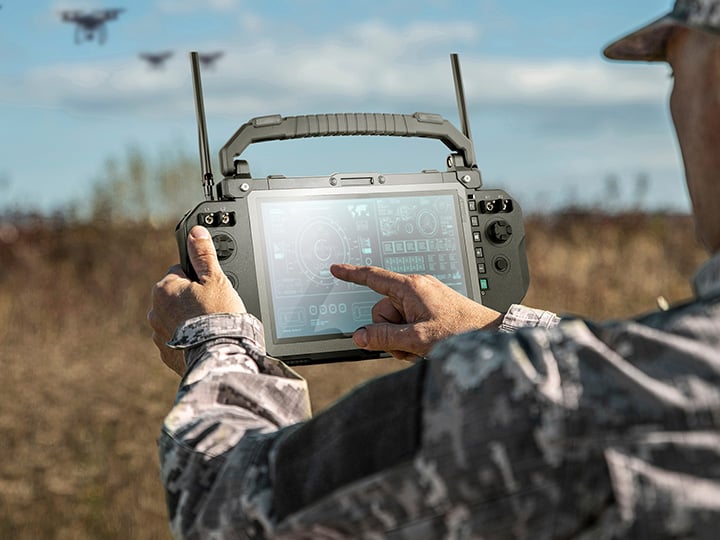
The rollout of 5G in Europe is still underway, although frontrunners are now benefiting from mature networks. The technology will further accelerate applications such as telehealth, remote monitoring, connected devices and smart emergency response systems.
For healthcare professionals, robust 5G devices enable real-time communication and data sharing in the field, significantly improving coordination and decision-making in critical situations.
Augmented and Virtual Reality (AR/VR)
AR and VR are also gaining ground in healthcare, both for training and clinical support. The European market for AR/VR in healthcare was previously estimated at around €2.8 billion by 2025 .
Combined with robust devices, AR headsets make it possible to access and analyze patient data without losing focus on the patient. A great advantage in acute situations where continuous monitoring is required.
VR is also widely used in medical training, where complex or high-risk scenarios can be safely simulated. These environments are adaptable in real time and often produce better learning outcomes than traditional methods.
Innovation for field operations
The emergence of these technologies highlights how radically healthcare delivery is changing in Europe. Robust technology is playing a key role in this by enabling innovations not only within hospitals, but also in ambulances and other operational environments.
By making AI, IoT, 5G and AR/VR also deployable in the field, robust solutions enable healthcare professionals to access critical information faster, collaborate better and deliver care more efficiently across the entire care pathway.
This blog post is a contribution from Getac. More information about Getac's robust solutions for emergency medical services can be found at www.getac.com.


